
Eleven Weeks Old: The Diagnosis
At 11 weeks old, Wesley couldn't hold his own head up yet. He hadn't rolled over. He hadn't really laughed. He was still figuring out that his hands belonged to him.
That's how old he was when we heard the word leukemia for the first time.
⸻
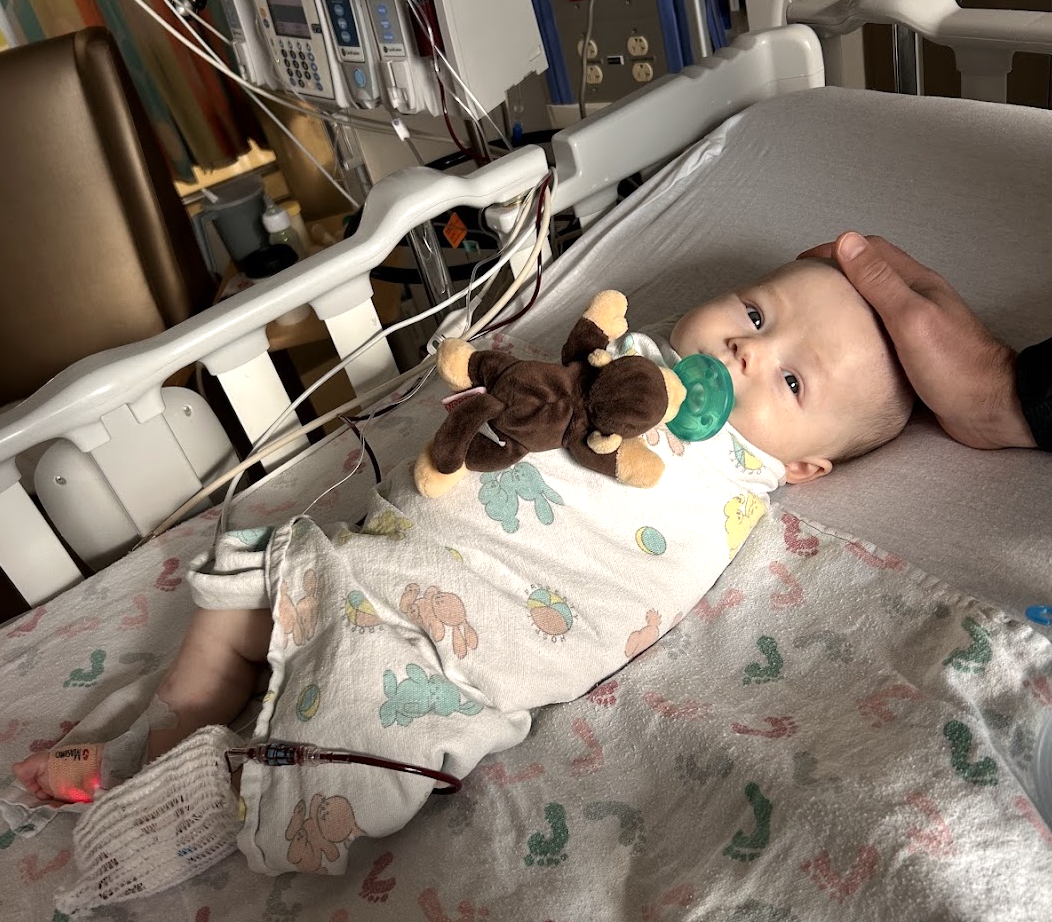
November 24, 2023: Wesley’s first blood transfusion - the day after his diagnosis.
The day it started
I remember the fluorescent lights in that first exam room more clearly than I remember most of what the doctor actually said. There's a kind of static that happens in your brain when someone says a word like that about your baby. You hear it, and then you spend the next several minutes trying to catch up to what you just heard.
What we eventually understood, once the static cleared, was that Wesley had Infant Acute Lymphoblastic Leukemia with a KMT2A rearrangement. Not the version of childhood leukemia most people picture. Infants diagnosed this young make up a small share of all ALL cases, and their disease behaves very differently than leukemia in older children. Historically, it's come with much harder odds.
We didn't know any of that yet. We just knew our son was sick, and that we were about to live somewhere other than home for a long time.
⸻
Life at Seattle Children's
We spent over a year in and out of Seattle Children's Hospital. I could tell you about the chemotherapy schedule, the counts we watched every morning, the isolation precautions, the way a hospital room starts to feel like a strange kind of home. But what I remember most are the small moments in between.
Wesley's first real laugh happened in that hospital room. So did his first time reaching for a toy on purpose. A nurse taught me how to swaddle him around his IV lines. Another brought him a tiny knit hat because his hair was starting to fall out and she didn't want him to be cold.
There was so much uncertainty in that year. We didn't know what his numbers would look like week to week. We didn't know how his body would respond. What we did know was that he was surrounded by people who were fighting for him just as hard as we were.
⸻
Why this became bigger than our family
Somewhere in that year, something shifted. We stopped only asking "will Wesley be okay" and started asking a bigger question: why are the treatment options for infants like him still so limited?
The honest answer is that infant leukemia is rare enough, and research funding for pediatric cancer overall is small enough, that progress has been slower than it should be. Many of the protocols used to treat kids like Wesley were developed decades ago. They're the best tools available right now. They are not the tools we should be satisfied with.
That question is where Dunn4Good came from. Not as a plan we made in advance, but as something we couldn't put down once we saw it clearly.
⸻
Where Wesley is now
Wesley rang the bell. He's in the maintenance phase of treatment now, and he started preschool this year. He has friends. He has opinions about what he wants for breakfast. He runs.
I won't pretend that means the story is over. There are still labs, still scans, still a version of relapse anxiety that doesn't fully go away. But he is here, laughing, reaching for things on purpose, exactly the way he was starting to back in that hospital room.
That's what research made possible for our family. It's why we keep fighting for it to be possible for the next family who hears that word for the first time.
Thank you for reading Wesley's story. It's the reason all of this exists.
With love, The Dunn Family + Dunn4Good Guild 💛